National Library of France
Professionals
Download
Gallica is the name of the digital library of the Bibliothèque Nationale de France (BnF). Launched in 1997, it can be accessed from anywhere in the world over the Internet.
As of April 2006, Gallica offered:
Since March 2004, there have been more than one million document searches every month. A complete success, Gallica is the only major library in the world to offer such an extensive online collection. Nonetheless, institutions around the world have steadily increased the number of similar online digital programs. In light of this trend, it is important that Gallica distinguishes its collections and services for the benefit of its various audiences. That is the purpose of this charter.
The BibUsages Project is a recent study of online digital library use. Its results show that Internet users want access to:
Today, Gallica is used by researchers, professionals, and enthusiasts. Its materials appeal to a wide variety of audiences. For example, educators use Gallica as a valuable learning tool. They appreciate the added value that both full-text and image-illustrated collections offer. In addition, they note the symbolic significance of the cultural heritage easily accessed through this digital library.
Although already very successful, Gallica must continue to grow and evolve. Enhancements to this invaluable resource must result from a balance between supply and demand.
How do you determine this balance? Until now, Gallica has created excessive layers of documentary knowledge. To find a more effective balance for the future, it will be necessary to return to Gallica's sources: the original BnF collections. From this perspective, Gallica is not a digital library of contemporary works that may or may not appear on the shelves of BnF. Rather, it is a digital library focusing on the wealth of printed materials, manuscripts, and audiovisual collections already available in BnF.
Today, coordinating Gallica within the network of its partner libraries poses a major challenge. Meeting this challenge and bringing together physically separated collections in a virtual digital space has many benefits: varying resources become more consistent; new, previously unimagined research possibilities emerge; connections between collections are uncovered; and an expanded view of cultural heritage develops. These are just some of the reasons why cooperation among national libraries is important. Cooperation can, therefore, lead to:
Gallica is the online digital library service created by BnF, a national library focusing on research. Its different lines of development are based on the following principles:
Gallica is a means of accessing the literary and graphic dimensions of cultural heritage.
It offers the public thematic bodies of knowledge centered on one or more library collections. Those collections span several BnF departments, each presenting a different type of document access. Users must be able to work on hundreds of documents within a given subject area, therefore Gallica wil provide groups of documents on a given author, current of thought or subject.
Its aim, once again, is not to place entire library collections online. Gallica does not attempt to present an exhaustive range of library materials.
Without taking for granted what has been Gallica's main strength-- its collections of authors' works--this digital library emphasizes another dimension of its collections. Every large research library has the responsibility to develop innovative new ways on of spreading knowledge, especially with regard to commercial publishing. Gallica's new focus is meeting this challenge.
Gallica reflects BnF's printed collections, which have entered the library system in a number of ways. These resources are rich, yet do not consist of a "classic" body of authors constructed from a purely academic perspective, as one would find in certain universities and research units. Gallica must offer bodies of research documents gathered from library materials that characterize the BnF collections, materials that are still underused. A certain portion of the 19th-century press represents one of the best examples. In this case, accessibility takes precedence over the rare nature of the works. Hence, more emphasis must be placed on "collections of sources" (as historians would see it) that are hard to access today, yet relevant to a wider public.
The body of authors included in the new Gallica system makes up the collections of sources. Each collection now has a manageable size and provides ample research material. Today, Baudelaire is easier to find than Sully-Prudhomme. One of Gallica's goals, therefore, is to offer literary periods not only of "major authors," but also lesser-known authors. Gallica will accomplish this like no other online tool, opening new avenues of research.
To meet this goal, Gallica will use primary source material whose symbolic importance is linked to BnF. For example, although parts of the photographic collections of Eugène Atget, Charles Nègre, and Charles Marville, as well as the engravings of Jacques Callot and Henri de Toulouse-Lautrec, have been republished in book form, BnF has archived the most important of those collections. It will be beneficial to treat image collections and sound recordings in the same way as philosophers and writers, by including learning tools that help increase understanding of a period or movement. Only an institution like BnF can follow this kind of approach. It will strengthen the concept of "bodies of knowledge" and bring consistency to BnF's offerings, which mostly interest those who search for materials from an historical perspective.
The process of selecting bodies of knowledge means that the presentation and content of Gallica will change during the year 2005. When you search Gallica in the future, you will have a number of access levels: topic, title, author, and, possibly, library collection. You will also be able to combine search criteria. As with Internet search engines, Gallica will allow you to search for more than just title and author.
Research tools include classic dictionaries, directories, bibliographies, and similar materials.
There is a strong demand for the digitization of research tools, such as dictionaries and special catalogs, especially materials that are out-of-print. The digitization of dictionaries within Gallica is limited to the image format as it currently exists. A simple technical solution using the image format, however, can now meet a large part of the demand: "Tables of Contents" allow readers to navigate among the current headings on each page (for example, ARAN – ARAP- ARAS).
This is an appropriate solution to consider in 2004 from a technical point of view. It can then be expanded to apply to specific Gallica objectives:
The priority is to offer the main French bibliographic tools out-of-print since the 16th century, from La Croix du Maine to Lorenz, and including the complete digitization of the Bibliographie de la France since 1811. With this program, BnF will meet the needs of the library network as well as researchers.
Gallica focuses primarily on works about France, in the French language, and published in France.
This focus distinguishes BnF from other similar libraries in other countries. BnF collections, nonetheless, have included foreign documents for centuries. This will be taken into account to avoid creating research boundaries that are too rigid.
Historic collections of manuscripts, rich in diverse languages, must be preserved despite Gallica's new focus on French language collections. The French language dominates the enhancements to Gallica. However, Gallica will regularly include foreign-language materials contained in BnF collections, especially when they complete or significantly add to the body of knowledge, or their absence degrades overall consistency. We will select first editions or landmark translations that are, in general, in the public domain. The proportion of these works will be decided on a program-to-program basis.
The same reasoning applies to the geographical reach of Gallica and its openness to Europe and the rest of the world, depending on the nature of the collections.
Technical and legal constraints make it necessary for Gallica to emphasize the French 19th-century portion of the collections in two ways:
The 19th century witnessed the rapid development of large scholarly collections that published and distributed new archival sources and the first complete collections of authors (in literature, philosophy, and other fields). Gallica naturally reflects this vital scholarly movement in France, especially in the field of history. To date, history collections have not been replaced, except for the republication of classic works.
The 19th century was also a great period for the organized distribution of scientific knowledge and political thought, not only through academic journals, but also through analytical surveys and dictionaries: this dimension will appear more prominently in the new Gallica. This is also true for geographical movement and the empowerment of the social sciences, both fundamental in increasing the influence of French schools of thought.
The BnF collections have their origins in much earlier times. Collections of materials from the early modern period, especially from the 16th to 18th centuries, need to be given the emphasis they deserve.
Following detailed analysis of digitized collections by subject area, the following needs to be affirmed:
The 20th century will be approached mainly through academic journals, especially those focusing on philosophy, literature, and art. Finally, Gallica will build collections on World War I, in which interest has recently been revived.
Imbalances between subject areas are apparent. The aim is not to correct imbalances systematically, but to do so in a way that reflects both the importance of the collections (including those of special collections departments and research interests.
| Subject | Total volumes | Monographs | Periodicals | Periodicals Titles | Images and Sound Recordings |
|---|---|---|---|---|---|
| Total | 66 246 | 52 764 | 13 482 | 417 | 78,840 images 30 hrs. of sound recordings |
| Dictionaries, Bibliographies, History of the Book | 1 041 | 451 | 590 | 20 | 0 |
| Philosophy | 3 000 | 2 559 | 441 | 10 | 0 |
| Religion | 2 616 | 2616 | 0 | 0 | 45,000 images (Dun Huang) |
| Histoiry | 13 130 | 9 659 | 3 471 | 72 | 11 040 images |
| Géography, Ethnology | 4 247 | 2 593 | 1 360 | 19 | 10,130 images Sounds recordings |
| Sociology, Education | 731 | 705 | 26 | 3 | 0 |
| Law | 3 124 | 2 993 | 131 | 5 | 0 |
| Economics | 2 540 | 2 053 | 487 | 19 | 0 |
| Political Science | 7 502 | 6 321 | 1 181 | 105 | Sounds recordings |
| Science, Technology | 11 594 | 9 296 | 2 592 | 55 | 500 images |
| Language, Linguistics | 1 408 | 737 | 671 | 21 | 0 |
| Literature | 14 000 | 11 658 | 2 342 | 79 | Sounds recordings |
| Fine-arts, Architecture | 605 | 492 | 107 | 1 | 4 470 images |
| Music, Performing Arts | 600 | 537 | 63 | 8 | 7 700 images Sounds recordings |
| Arts de vivre (Leisure & Lifestyle) | 108 | 88 | 20 | 1 | 0 |
Currently, Gallica covers three subject areas particularly well:
History and literature are major themes in the BnF collections, while the sciences are in high demand from the research community.
These subjects do not have to be re-examined, since they have reached the critical level at which digital collections become useful for research. Although it may be necessary to control the growth of these three subject areas, they must continue to be developed.
By contrast, certain smaller collections, such as linguistics, are already well balanced.
In the near future, Gallica will further develop under-represented subject areas, including philosophy, religion, and political science.
The arts will also be expanded based on joint projects with the Institut National de l’Histoire de l’Art (INHA) and the wealth of materials held in the main BnF departments of this general subject area: Music; Engravings and Photography; and Performing Arts.
Academic journals are now in high demand. Gallica is committed to systematically filling the gaps (missing issues) and adding the most important titles to the production chain in response to growing demand.
But, this plan can only be carried out if technical progress is made allowing full access to the journals (navigation within tables), a type of access that must be improved in Gallica.
The daily press is another scholarly and technical field essential to Gallica. The daily press of the 19th century remains difficult to access, although it represents a source of primary importance in research. Only a limited selection of titles is available because the digitization of works from Théophraste Renaudot to Hubert Beuve-Méry, ideal for research, has not taken place.
Technical solutions for the historic large-format daily press are being studied in an ambitious plan to launch about 3 million pages in 2005. This will represent a major step forward in promoting French language and culture around the world. This plan must not, however, negatively affect the ongoing enhancement of Gallica. It will require additional resources. The rebalancing of time periods discussed above is in addition to the digitization of the 19th-century French daily press; that rebalancing is part of the continuing expansion of Gallica.
It is highly beneficial to link together the expansion of BnF's collections of printed materials, images, and sound recordings.
There will exist connected groups of digitized texts and images that Gallica will offer as unique research tools. This will allow valuable interdisciplinary studies, which are still too few in number. Digital technology offers new opportunities in this area. For example, connecting printed music collections to sound recording archives will strengthen interest in their conservation.
The image and sound recording collections selected for digitization must be consistent with the function of Gallica as a digital research library. This involves carefully planning access to these materials, reorienting their presentation, and increasing the amount of materials, while maintaining an appropriate numerical balance between images and text.
This effort must be clearly distinguished from the separate development of the BnF image bank, which has a commercial purpose and is managed by BnF's Reprographic Department (Département de la Reproduction).
Gallica is a large online research library. BnF will continue its pioneering work in making large numbers of texts, images, and sound available via the web, while allowing other institutions to create technical and scholarly added value.
Gallica's policy is significantly different from that of commercial publishers. All the materials on the site are royalty-free (mostly in the public domain), printable, and downloadable for strictly private use.
BnF is often asked to create collections of authors' works using electronic publishing. BnF approaches these requests in the following way:
More and more publishers are offering dictionaries in the CD-ROM format, such as the Grand Dictionnaire Universel du XIXe Siècle, by Pierre Larousse. Investing in the text format is costly. This is why BnF will improve online access and pay special attention to digitizing dictionaries and research tools. At the same time, it will put online, in image format, a number of out-of-print resources.
Finally, BnF is planning to collaborate with academic journal publishers to place their materials online. Journals represent a major strength of Gallica, making a close collaboration with journal publishers easy to organize. A similar cooperation has been planned for press publishers of current newspaper titles.
Gallica is in a position to forge partnerships with various research organizations.
BnF cannot respond to all the offers from numerous research teams to collaborate on different database projects for rare documents, each requiring project-specific methods. When such collaboration is possible, the roles can be divided. For example, in the case of manuscripts:
Similarly, Gallica will develop digital databases offering specific access to BnF's iconographic collections, such as Mandragore (for Medieval illuminated manuscripts). These databases have special directories aimed at research. Gallica will contain the digitized text of the manuscripts, as well as relevant incunabula (early printed books).
The future design of the Gallica Web site will include links to these iconographic collections. In this way, Gallica strengthens its primary mission as a repository of digital documents.
The French Ministry of Culture (Ministère de la Culture et de la Communication) maintains a database of ongoing digitization projects. At this time, the resources listed are quite varied.
The ministry's Department of Literature and the Promotion of Reading (Direction du Livre et de la Lecture) is seeking to increase the visibility of projects focusing on France's literary heritage. In the process, it would like to develop closer ties to projects that could involve the Subdepartment of Libraries of the French National Ministry of Education (Sous-Direction des Bibliothèques of the Ministère de l’Education Nationale). BnF's expertise in France's literary heritage puts it in a unique position to participate in this particular cataloging project.
Today, the prospects for joint digitization projects lead us in two directions:
Special treatment must be reserved for regional history, which remains important from the point-of-view of regional cooperation and corresponds to the first "avenue" discussed above, by which Gallica will bring together related collections.
The success of academic journal programs covering 19th-century learned societies creates new possibilities for enhancing the value of French national heritage trust collections distributed between BnF and municipal libraries (as well as archives).
We emphasize the:
| Volumes | 1,041 volumes, including 451 monographs, usually in several volumes, and 20 academic journals, amounting to 590 volumes |
|---|---|
| Dictionaries and Encyclopedias | 210 volumes: examples are, Dictionnaire Historique et Critique, by Pierre Bayle; Encyclopédie, ou Dictionnaire Raisonné des Sciences, des Arts et des Métiers, by Denis Diderot and Jean d'Alembert; Grand Dictionnaire Universel du XIXe Siècle, by Pierre Larousse; and Dictionnaire des Dictionnaires, by Paul Guérin. |
| Bibliographies and Catalogs | 241 volumes: examples are, Dictionnaire des Ouvrages Anonymes, by Antoine-Alexandre Barbier; Les Supercheries Littéraires Dévoilées, by Joseph-Marie Quérard; Manuel du Bibliophile, by Gabriel Peignot; Correspondance de Plantin: Œuvres du Bibliophile Jacob; and Advis pour Dresser une Bibliothèque, by Gabriel Naudé |
| Academic Journals | 590 volumes (20 titles) divided between general knowledge journals (such as, Revue Encyclopédique and Magasin Encyclopédique), bibliophile journals (such as, Bibliophile Ancien ou Moderne and Bulletin du Bouquiniste), and literary journals (such as, Journal Littéraire de la France). |
| Special Features | 16th-century Lyon printings from the Bibliothèque Municipale de Lyon. |
| Supplements |
|
|---|---|
| Collections |
|
| Planned Improvements | Priority: specific specifications for improving the search functions for dictionaries that do not exist on the market in digital format. In 2004, specifications should make it possible to navigate by current title (ARAN-ARAP-ARAS). |
2,300 printed volumes
| Volumes | 3,000 volumes, of which 85% are monographs |
|---|---|
| Languages | French (61%). Other languages include German (19.2%), Italian (8%), and English (7.1%). |
| Time Period Covered | Mostly 18th (22.2%) and 19th (32.7%) centuries. |
| Texts |
|
| Academic Journals | 2 titles are currently available: Revue Philosophique de la France et de l'Etranger and Revue de Métaphysique et de Morale. Coverage is complete, within the limits of copyright. |
| Special Materials | - |
| Supplements | The Gallica philosophy collection will be refocused on philosophy in the French language (including non-French philosophers who have written in or translated works into French), providing links to libraries outside France for the remaining material.
|
|---|---|
| Collections | Digitization of a selection of lectures given by Gilles Deleuze (recordings of lectures given between 1979 and 1984 at the Université de Paris-VIII). |
| Planned Technical Improvements | For the Deleuze lectures (an exception in terms of copyright), BnF will obtain special approval from copyright holders to include the material in the Gallica audio server. |
5,000 printed volumes
Progress of the R.-P. Droit/L. Ferry project led by the French Ministry of National Education (Ministère de l'Education Nationale) (collection of philosophy works).
| Volumes | 2,616 volumes, focused on Judeo-Christian works (especially Christianity) |
|---|---|
| Languages | 150 volumes in ancient languages (Latin and Hebrew), the remainder in French. |
| Time Period Covered | Works focused on the 16th, 18th, and 19th centuries. |
| Tools | No tools are currently available (copyright issues) |
| Texts |
|
| Academic Journals | Bulletin de la Société d'histoire du protestantisme ; Acta sanctorum ; Journal ecclésiastique. |
| Special Materials | Digitization of Dunhuang manuscripts is in progress (P. Pelliot collection) and will partially restore the Buddhist collection: 45,000 images. The breadth of this collection goes beyond the field of religion. |
| Supplements | Double the Gallica religious collections, focusing on two main themes:
|
|---|---|
| Collections | There is a proposal to digitize Géographie Sacrée, by Bourguignon d'Anville, which amounts to about one hundred maps from the 17th and 18th centuries. |
| Planned Technical Improvements | For religions other than Christianity, Gallica plans to create tables of contents corresponding to the page numbering in non-Latin characters. |
5,000 printed volumes
| Volumes | 13,130 volumes |
|---|---|
| Languages and Time Period Covered | See belows |
| Tools | 853 volumes, or 6.5% of total:
|
| Sources | 5,511 volumes, or 42% of total (antiquity: 250; Middle Ages: 87; early modern period: 3,700; and modern period: 343):
|
| Studies | 3,306 volumes, or 25% of total (mainly French):
|
| Academic Journals | 72 titles, nearly all in French, including:
|
| Special Materials |
|
| Supplements | Three themes:
|
|---|---|
| Collections | Several collections could be envisaged for the near future: - Digitization of drawings from the Gaignières Collection, beginning with 1,056 topographical documents - Collection of images from the French Revolution, by migration from existing video disks, if possible - Digitization of 35 volumes of color coats-of-arms by Charles d'Hozier - World War I collection (front-line newspapers), in partnership with BNUS and BDIC |
| Planned Technical Improvements | Links to regional portals |
20,000 printed volumes; graphic materials to be counted.
| Volumes | 3,953 volumes, including 1,360 volumes of periodicals, amounting to 19 titles |
|---|---|
| Languages and Time Period Covered | See below |
| Tools | Few bibliographic tools are available: only three titles for ethnology |
| Text Sources | 53% from two main groups:
|
| Monographs |
|
| Academic Journals | Fifteen journals on geography and ethnography (including L'Ethnographie; Bulletin de la Société d'Anthropologie; Annales de Géographie de Paris; and Revue Maritime et Coloniale), as well as four titles specializing in travel (Journal des Voyages, Tour du Monde, Exploration, and Nouvelles Annales des Voyages) |
| Special Materials | Particularly rich in special materials, these include:
|
| Supplements |
|
|---|---|
| Collections | The La France en Amérique/France in America project, which studies the influence of France on North American culture, has been validated (1,500 documents, including about 600 in phase 1) In the medium-term, this collection will be accompanied by two other collections:
|
| Planned Technical Improvements | There are two areas to develop as a priority:
|
6,000 printed volumes; graphic materials to be counted.
| Volumes | Sociology : 231 volumes Education : 500 volumes |
|---|---|
| Languages | Sociology : 95 % French Education : French |
| Time Period Covered | Sociology: second half of the 19th century, focusing on the development of sociology in France Education: 18th and 19th centuries |
| Tools | Education: four dictionaries, including the Dictionnaire de Pédagogie et d'Instruction Primaire, by Ferdinand Buisson |
| Sources |
|
| Texts |
|
| Academic Journals |
|
| Supplements | Sociology: Journals, such as Bulletin de l'institut Français de Sociologie and International Review of Sociology, and additions to the collections of major authors |
|---|---|
| Collections | Education: three collection proposals for the medium-term:
|
| Planned Technical Improvements | Sociology: Establish ties to philosophy and economics in the future Gallica design |
| Volumes | 2,519 volumes |
|---|---|
| Languages | Mostly in French |
| Time Period Covered | Mainly 18th (31%) and 19th (41%) centuries |
| Tools |
|
| Sources |
|
| Collection of critical analysis and legal doctrine | 1,718 volumes. There is an overall focus on the major treatises of ancient law commentators, especially those of criminologists: Daniel Jousse and Pierre-François Muyard de Vouglans; Agostino Barbosa and Ostiensis (canonists); and Dayoz and Denis Gothofredus (glossators). The collection essentially consists of French jurists (such as Gui Pape, Loisel, and Pothier), but also includes Italian (such as Balde and Bartole), English (such as Bentham), and German jurists (such as Pufendorf). Two areas have been developed in Gallica:
|
| Academic Journals | 131 volumes, comprising 5 titles: Revue de Législation Ancienne et Moderne Française et Etrangère; Nouvelle Revue Historique de Droit Français et Etranger; Revue Historique de Droit Français et Etranger; Revue Générale de Droit International Public; and Le Conservateur, Revue de Droit International. |
| Supplements | It will be beneficial to supplement in the long run:
|
|---|---|
| Collections | Digitization of Bulletin des lois (a gift from the Ecole Nationale d'Administration/ENA) – first section to be completed by 2008 |
| Planned Technical Improvements | As for dictionaries, Gallica is considering the development of specific kinds of access to Bulletin des Lois: tagging material and the use of tables. |
3,200 printed volumes
| Volumes | 2,540 volumes |
|---|---|
| Languages | Mostly in French |
| Time Period Covered | Mainly 18th (46%) and 19th (52%) centuries.The French Revolution is well represented. |
| Tools | 28 volumes: Classic French works from the 19th century on the free-market economy: Dictionnaire de l'Economie Politique Contenant l'Exposition de la Science, by Charles Coquelin and Gilbert-Urbain Guillaumin; Nouveau Dictionnaire d'Economie Politique, by Léon Say and Joseph Challey; Dictionnaire du Commerce, de l'Industrie et de la Banque, by Yves Guyot and Artur Raffalovitch; and Dictionnaire des Finances, by Léon Say. |
| Sources | 1,615 volumes:
|
| Critical analysis | 410 volumes. Chronologically, the best-represented works are those on free-market philosophy of the 19th century and the French economics school, as well as social economics of the same period. |
| Academic Journals | 19 titles, or 487 volumes including Journal des économistes, le Bulletin de l’Institut international de statistique, les Annales de statistique, la Revue d’économie politique and Archives de statistique. |
| Compléments ponctuels | Supplementary material will be added to subject areas addressed by major texts on free trade and capitalism, neoclassical economics, the physiocrats, and Marxist theory, as well as texts and sources on international trade, the French colonies, and the development of banks and stock markets. A more balanced collection than that of law, this field will need its strengths to be supported by additional sources and academic journals. Refocusing of French works (particularly of the modern period, excluding the French Revolution; and filling gaps in the early modern period). |
|---|
3,000 volumes of printed material
Digitization of Revue Economique by the Service Commun de la Documentation (SCD), Université Lumière, Lyon II, as part of the social sciences program of the Sous-Direction des Bibliothèques et de la Documentation.
| Volumes | 7,851 volumes |
|---|---|
| Languages and Time Period Covered | Mainly France |
| Tools | 58 volumes. Inconsistent collection of 19th-century works. A number of dictionaries, such as Dictionnaire de l'Administration Française, by Maurice Block, and bibliographies, such as Bibliographie Saint-Simonienne, by Henri Fournel. |
| Sources | 4,949 volumes (French Revolution and the 19th century)
|
| Texts and Critical Analysis |
|
| Academic Journals | 105 titles, or 1,181 volumes: academic journals (Annales de l'Ecole Libre des Sciences Politiques); journals of opinion (such as Mercure de France and Ami du Roi et de la Religion). The time period covered for journals of opinion is limited to the era of the French Revolution, for which there is a large amount of digitized material. |
| Special Materials | Political speeches (such as those of Paul Déroulède and Raymond Poincaré), recorded as part of the work of the Musée de la Parole (Museum of the Spoken Word). |
| Supplements | Rebalancing of collections emphasizing the 16th , 17th and 19th centuries, particularly in the following ways:
|
|---|---|
| Collections | Currently in progress: - a program on the workers' movement from 1870 to 1940, in collaboration with Codhos (Collectif des Centres de Documentation en Histoire Ouvrière et Sociale), to add activist documents to the collection (about 500) - digitization of 26 important titles of the French daily press of the 19th and turn of the 20th centuries, representing about 3 million pages – cf. file below. In addition, it would be beneficial, in the medium-term, to digitize Archives Parlementaires. |
| Planned Technical Improvements | - |
9,000 volumes of printed materials
Digitization of Revue Française de Science Politique by the Service Commun de la Documentation (SCD), Université Lumière, Lyon II, as part of the social sciences program of the Sous-Direction des Bibliothèques et de la Documentation.
BnF has undertaken the digitization of 26 important titles of the French daily press of the 19th and turn of the 20th centuries, amounting to about 3 million pages, which constitutes the largest online collection of newspapers in the world. Gallica lacks a full spectrum of contemporary history in this area of sources on the written press from Emile de Girardin to Georges Clemenceau.
The following titles will be included: Le Temps, Le Figaro, L'Humanité, La Croix, Le Petit Parisien, La Presse, Le Matin, L'Action Française, Le Petit Journal, L’Aurore, La Justice, Le Constitutionnel, Le Gaulois, Le Siècle, Le National,Le Rappel, L'Intransigeant, L’Univers, Gil Blas, and La Lanterne.
This program will be carried out over a period of five to seven years.
These titles will be digitized strictly according to Gallica digitization policy. This involves processing, above all, issues of these titles now in the public domain. For copyrighted material, there must be case-by-case agreements with the press publishers holding the copyrights. These agreements are aimed at possibly cooperating with the publishers' own online programs, which, in general, cover recent years.
This flexible practice protects the interests of both parties:
The following program has been planned:
| Volumes | 11,594 volumes (including psychology, psychiatry, psychoanalysis, and physical anthropology) |
|---|---|
| Languages and Time Period Covered | Mainly 19th century (61%), while the 18th and 20th centuries represent 11% and 10%, respectively. |
| Distribution of Subjects (in volumes) | General science: 1,859; mathematics: 704; astronomy: 364; physics: 838; chemistry: 1,288; earth sciences: 166; paleontology: 139; life sciences: 266; botany: 699; technology: 734; medicine: 2,879; psychology: 137. |
| Tools | 389 volumes:
|
| Sources | 419 volumes, from the mid-17th to the mid-19th centuries, mostly from the fields of medicine and technology because of the abundant material on these subjects: scientific expeditions and missions (such as those of Bory de Saint-Vincent); official reports and proceedings of meetings and exhibitions; official government reports on the state of science; scientific studies; legislation on scientific practices; and architecture aimed at scientific research and studies. |
| Texts and Critical Analysis |
|
| Academic Journals | 55 titles, or 2,592 volumes: serial publications from the French Academy of Sciences and other equivalent institutions in Europe; periodicals for the general public, such as Les Causeries de la Science, or specialists: Annales de Physique et de Chimie and Journal des Mathématiques Pures et Appliquées, digitized in partnership with Cellule Mathdoc. All disciplines are covered, except earth sciences. |
| Special Materials | 489 images, mainly from partner institutions: Museum d'Histoire Naturelle and Musée de l'Homme (Museum of Natural History and Museum of Man, respectively) |
| Supplements | It will be necessary to:
|
|---|---|
| Collections |
|
| Planned Technical Improvements |
|
18,000 printed volumes; graphic materials to be counted.
| Volumes | 1,408 volumes |
|---|---|
| Time Period Covered | Balanced coverage, thanks to the digitization of Archives de la Linguistique Française and Philological Tools, completed title by title |
| Répartition | Généralités : 1859 vol., mathématiques : 704 ; astronomie : 364 ; physique : 838 ; chimie : 1288 ; sciences de la terre : 166 ; paléontologie : 139 ; sciences de la.vie : 266 ; botanique : 699 ; technique : 734 ; médecine : 2879 ; psychologie : 137. |
| Tools | 142 volumes of language dictionaries.
|
| Texts | 595 volumes: balanced collection built around three themes: classic linguistics (88 volumes), texts relating to the French language (279 volumes), and other languages (228 volumes), together offering a representative image of the evolution of languages. Linguistic works of the turn of the 20th century, which are still subject to copyright: beyond the scope of Gallica. Collection focusing on the regional languages of France, including several hard-to-access texts, beyond those of the association Félibrige (champions of the Provençal language). Significant collection of African language materials and the works of major French orientalists. |
| Academic Journals | 671 volumes, including 21 titles, a remarkable, yet little known, collection: Revue des Langues Romanes, Litteratur für Germanische und Franzosiche Philologie, Revue de Phonétique, and Romania, among other titles. |
| Special Materials | Sound recordings from Archives de la Parole. |
| Compléments ponctuels |
Supplement will be linked to regional learned society journal programs. - Gallica will strengthen the historical dimensions of this linguistic collection, beyond the classic texts of Gilles Ménage and Claude Favre de Vaugelas.
|
|---|---|
| Collections | Gallica will proceed:
|
| Planned Technical Improvements | Gallica will develop specific specifications for improving search functions, especially for dictionaries that do not exist in digital form on the market. In 2004, specifications should make it possible to navigate by current title (ARAN-ARAP-ARAS). |
2,000 volumes of printed materials and sound recordings
| Volums | 14,000 volumes, 86% of which are monographs and 14% periodicals |
|---|---|
| Languages | 90% in French. Emphasis on authors writing in French and texts in other languages translated into French. |
| Time Period Covered | Mainly 20th century (48%) [19th-century texts and also older texts known for their 19th-century editions]; 18th century (17%), especially the period of the French Revolution. 17th (13%) and 18th century (13%) |
| Tools | Digitization of a limited number of special bibliographies, focusing on Ronsard, Bossuet, Voltaire, and others. |
| Texts |
|
| Critical analysis |
|
| Academic Journals | 79 titles, including 2,342 volumes, divided into general journals (debates and political and cultural news), literature review journals, and literary criticism. |
| Special Materials | Some isolated sound recordings: voice recordings of some major authors, such as Apollinaire and Barrès. Special presentations of authors and their bodies of work: Proust, Zola, and Voltaire (with manuscripts) |
| Supplements | Two priorities:
|
|---|---|
| Collections |
|
| Planned Technical Improvements | - |
20,000 volumes of printed materials
| Volumes |
|
|---|---|
| Time Period Covered |
|
| Tools | Two bibliographies, including Bibliographie Méthodique et Raisonnée des Beaux-Arts, by Ernest Vinet, and eight dictionaries, such as Dictionnaire Portatif de Peinture, Sculpture et Gravure, by Antoine-Joseph Pernety, and Dictionnaire Raisonné du Mobilier Français, by Eugène Viollet-Le-Duc. |
| Sources | Les Catalogues des Salons des Beaux-Arts of the 19th century (48 volumes) and isolated letters: Lettre à Théophile Gautier, by T. Rousseau; Lettres de Eugène Delacroix; and more specialized studies concerning institutions: Ecole des Beaux-Arts (Fine Arts Academy), competitions, and more. Projets d'Architecture (29 volumes), to review in cooperation with INHA. |
| Texts and Critical Analysis | For the fine arts, there is a mixed collection consisting of:
|
| Academic Journals | 107 volumes of Gazette des Beaux-Arts. Works recently digitized include Nouvelles Archives de l'Art Français and Memoranda from meetings of learned societies of the departments of the University of Paris-Sorbonne, Fine Arts Section. |
| Special Materials | Digitization of 1,061 images from the Lequeu Collection. In addition, 58 manuscripts are available through Gallica, including illuminated manuscripts contained in the Mandragore database (3,276 images). Architecture: 133 images from the Boullée Collection, essentially materials on city planning. |
| Supplements | Emphasis will be placed on digitizing multidisciplinary documents, including the major art journals. Trade shows are well represented and will continue to be digitized. |
|---|---|
| Collections | - |
| Planned Technical Improvements | - |
| Volumes | Music: 600 volumes |
|---|---|
| Time Period Covered | 51% from the early modern period, 12% from the period of the French Revolution, and 37% from the modern period |
| Tools | There are no bibliographies and no dictionaries |
| Source Material |
|
| Studies and Musicologies |
|
| Academic Journals | Eight periodical titles, representative of both musical literature and music criticism: Revue Musicale, France Musicale, Journal de Musique, Tribune de Saint-Gervais, and others. |
| Special Materials |
|
| Supplements | It will be beneficial to:
|
|---|---|
| Collections | There are several collections:
|
| Planned Technical Improvements | - |
2,000 printed volumes; graphic materials to be counted
Plan by the Institut de Recherche sur le Patrimoine Musical en France (CNRS) to put online the Euterpe database, which is a directory of representations of music and musical instruments in art. This challenge partially readdresses a BnF project to digitize the Pomme de Mirimonde Collection, for the part of the collection to which BnF holds the copyright.
| Volumes | 88 volumes and 15 volumes in the process of being uploaded. |
|---|---|
| Language | Mostly in French. |
| Time Period Covered | Mainly the 19th (43 volumes) and 18th centuries (23 volumes). |
| Monographs | This collection is divided into:
|
| Academic Journals | One title: Le Journal des Dames et des Modes |
| Special Materials | - |
| Supplements | This very incomplete collection has suffered from the focus, to date, on the classic works of philosophy, literature, history, and other areas. It must be regularly supplemented with reference bibliographies and relevant primary source materials from BnF, especially collections from the Bibliothèque de l'Arsenal (Arsenal Library), which is developing a thematic collection of materials on the history of daily living. |
|---|---|
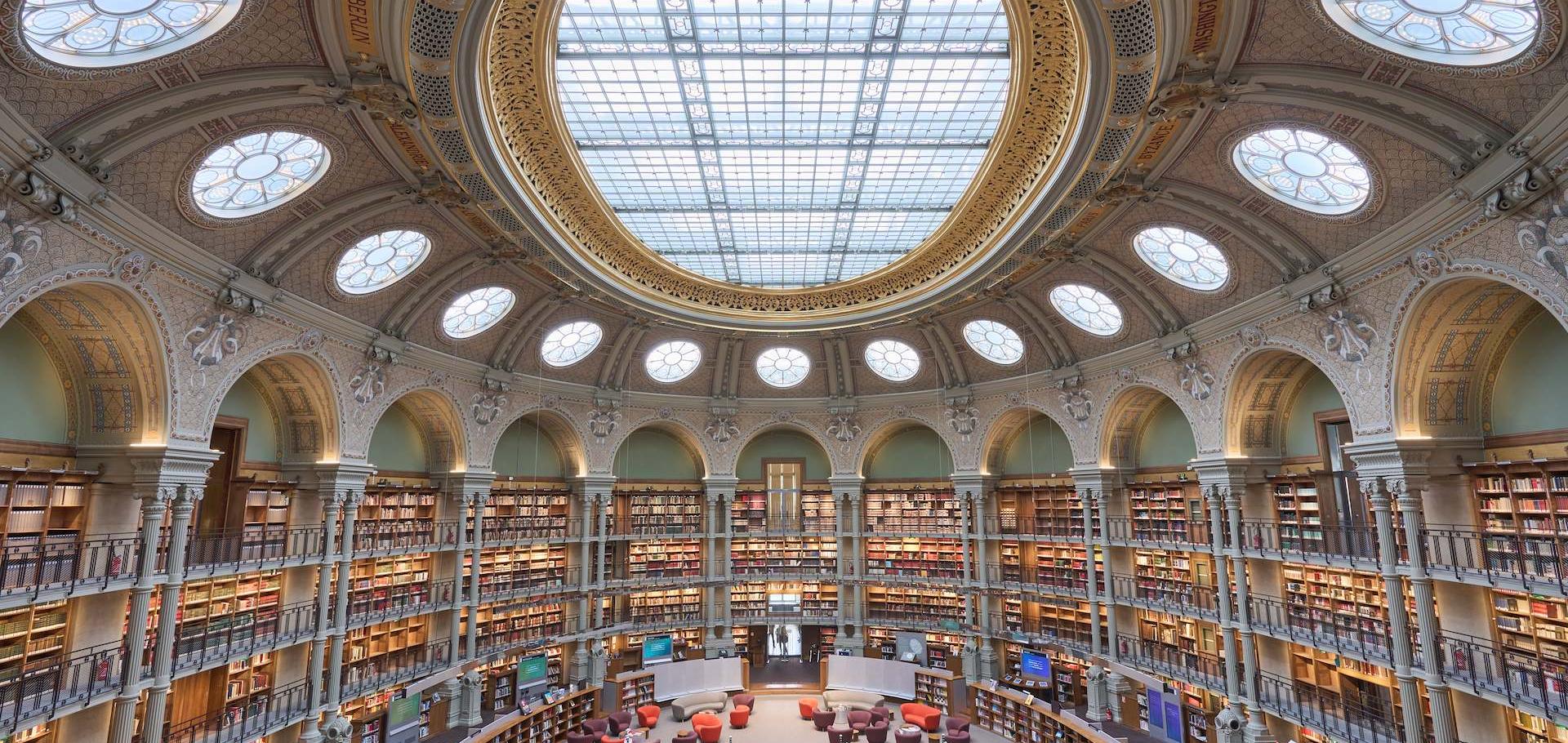
| Collections | Thematic collections of engravings will be used, as part of the image collections of the Salle Ovale, the reference room of the Richelieu Library of BnF. A collection of clothing can also be planned for. |
| Planned Technical Improvements | - |
1,100 printed volumes; graphic materials to be counted.
Thursday, December 10, 2009